

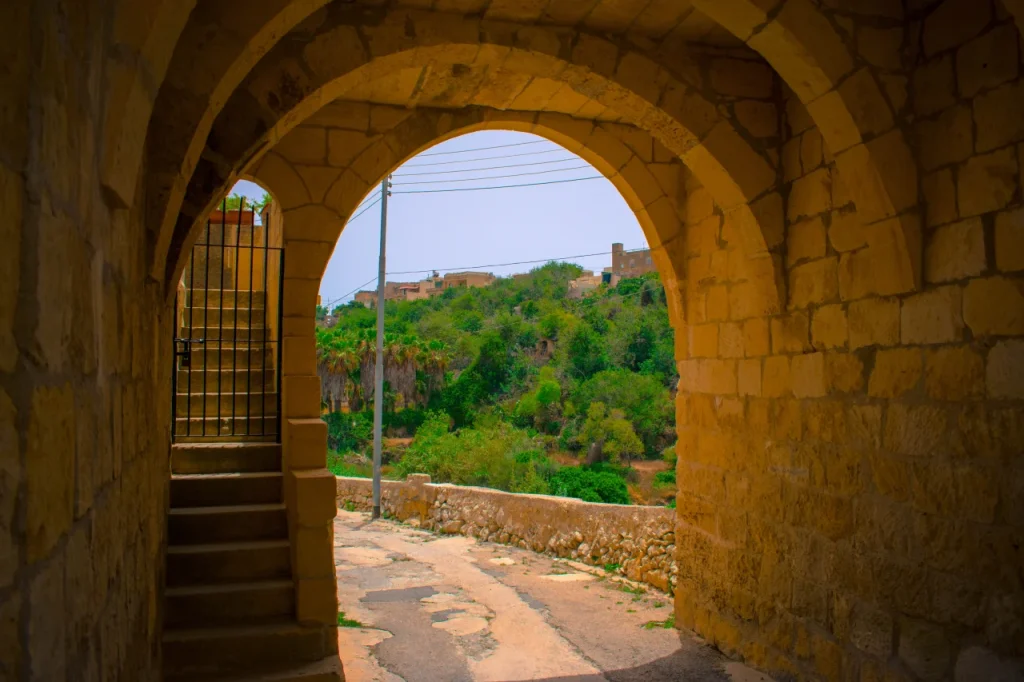
Il-Lunzjata Valley is one of those places that changes the pace of a day in Gozo. A short distance from the streets of Victoria, the landscape narrows into a cultivated green corridor of stone walls, fruit trees, reeds, water channels and small fields. It is not a conventional attraction with a ticket office or a fixed route. Its appeal lies in walking slowly through a living rural landscape and noticing how water, farming, faith and history meet in one compact valley.
Why Il-Lunzjata feels different
Much of Gozo’s countryside is open, sunlit and exposed. Il-Lunzjata feels more enclosed and sheltered. The sides of the valley frame terraced plots below, while vegetation gathers around the places where water runs or collects. In the greener months, the contrast with the surrounding limestone landscape can be striking.
The valley lies to the south-west of Victoria, between the village areas of Fontana and Kerċem. Its position makes it useful for visitors who want a modest countryside walk rather than an all-day hike. It also offers a quieter companion to the Citadel, churches and busy squares of central Victoria.
Water, cultivation and the valley’s green character
Water explains much of Il-Lunzjata’s character. Natural springs have long fed channels that distribute water to cultivated plots, supporting vegetable gardens and trees. The official Visit Gozo walking guide describes reeds, olives, almonds, pomegranates and carobs within the valley. Conditions change with the season, so the landscape may look lush after wetter periods and more subdued during the dry summer.
This traditional water management is part of what makes the valley worth seeing. Look for channels, retaining walls and the relationship between the slopes and the fields below. They show how generations of farmers adapted a small supply of freshwater to productive use.
The historic gateway and fountain
A handsome stone gateway marks the best-known entrance to the valley. Visit Gozo’s Dwejra walking guide dates it to 1698, during the rule of Grand Master Ramón Perellos y Roccaful. The Knights of St John also used the valley as a hunting ground, adding another layer to a place now valued mainly for agriculture, nature and walking.
A nearby fountain was also built in 1698 and restored in 2007. Together, the gateway, fountain and watercourses create a strong sense that Il-Lunzjata is a cultural landscape: its beauty is inseparable from the way people have shaped and used it.
The Annunciation chapel
The valley takes its name from the Annunciation and a chapel dedicated to the feast stands close to the entrance. The official walking guide records an earlier cave chapel dating from 1347 and says the present chapel was built in 1629. Even when the building is closed, its setting helps visitors understand the long connection between Gozo’s rural communities, cultivated land and small places of worship.
Please treat the chapel as a place of worship. Opening cannot be assumed and services or local observances should take priority over sightseeing.
Nature and wildlife
Il-Lunzjata forms part of Gozo’s Natura 2000 network. Visit Gozo’s official route notes identify the valley as habitat for the Maltese freshwater crab and the painted frog. Wildlife is easiest to appreciate by watching quietly from a respectful distance. Do not enter water channels, turn stones, handle animals or disturb vegetation to obtain a photograph.
When to visit
Late autumn, winter and spring usually show the valley at its greenest, while cooler temperatures make walking more comfortable. Early morning and late afternoon can provide softer light and a calmer atmosphere. Summer visits are still possible, but the landscape may be drier and shade should not be relied upon throughout the route.
Rain demands caution. The official Dwejra Walk guide warns that a wet-season crossing in the valley can become slippery or even impassable, with a road detour required. Never try to force a crossing through fast or deep water. If conditions look uncertain, turn back and use surfaced roads.
Planning a short walk
There is no single compulsory itinerary. A simple visit can begin near the historic gateway, continue along the established route through the cultivated landscape and return the same way. More confident walkers can incorporate the valley into a longer circuit involving Victoria, Fontana or Kerċem. Our guide to walking around Gozo explains the island-wide essentials for footwear, heat, navigation and bus planning.
- Wear closed shoes with dependable grip.
- Carry drinking water, even for a short outing.
- Use sun protection and avoid the hottest part of summer days.
- Check the forecast and recent rain before setting out.
- Use an offline map and remain on public, established routes.
Accessibility and practical expectations
Visit Gozo lists Il-Lunzjata as accessible for persons with disability, but visitors should still expect a rural environment in which gradients, surfaces, water and temporary obstructions can vary. Anyone with specific mobility needs should check current access locally and consider approaching only the most suitable section rather than assuming that every path will be step-free.
The valley has limited visitor infrastructure. Bring what you need, do not count on toilets or refreshments within the valley itself and use nearby Victoria, Fontana or Kerċem for services. A visit also pairs well with the less familiar places in our guide to Gozo’s hidden treasures.
Sources and review
Information reviewed 25 July 2026 using Visit Gozo’s Il-Lunzjata Valley listing, the official Dwejra Walk guide and the Il-Lunzjata Valley reference page. Routes, access and ground conditions can change; check locally before travelling.
Plan your visit
Frequently asked questions
Where is Il-Lunzjata Valley?
Il-Lunzjata Valley lies south-west of Victoria, between the village areas of Fontana and Kerċem in Gozo. It can be visited on a short countryside outing or included in a longer walk.
What is special about Il-Lunzjata Valley?
The valley combines spring-fed agriculture, traditional water channels, a historic 1698 gateway and fountain, an Annunciation chapel and protected natural habitat in a compact rural landscape.
When is the best time to visit Il-Lunzjata Valley?
Late autumn, winter and spring generally offer greener scenery and cooler walking temperatures. After rain, paths and crossings may be slippery or impassable, so check conditions first.
Is Il-Lunzjata Valley accessible?
Visit Gozo lists the valley as accessible for persons with disability, but it remains a rural setting with variable surfaces, gradients and wet-weather conditions. Check current access locally for specific mobility requirements.