

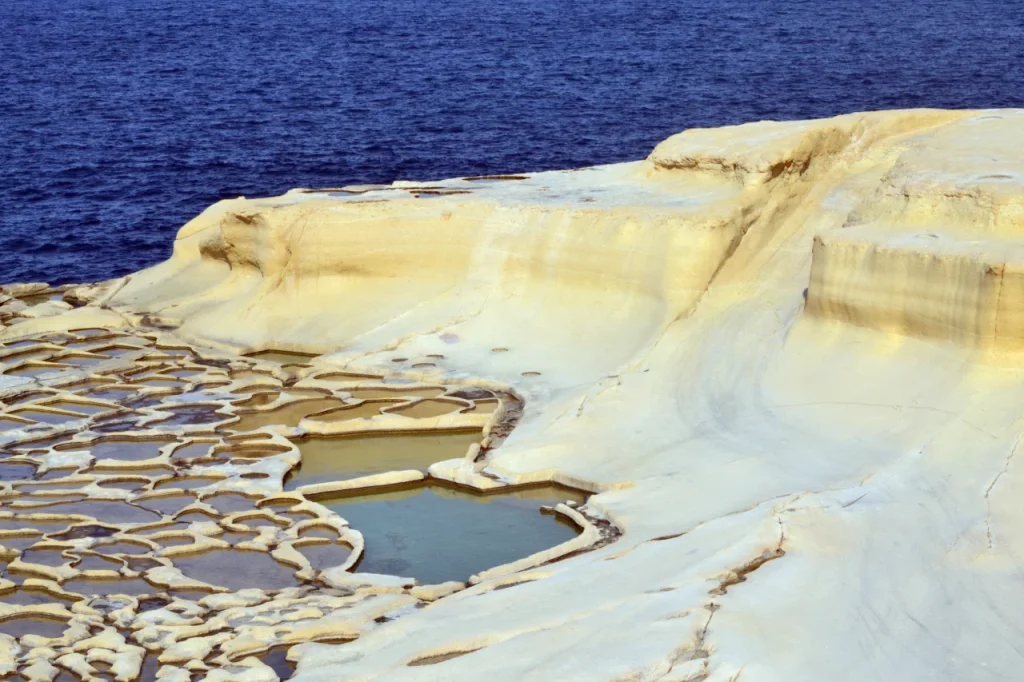
On Gozo’s northern shore, the limestone seems to turn into a vast geometric drawing. Hundreds of shallow rectangles catch the sky, change colour with the brine and form a chequerboard between the coastal road and the Mediterranean. These are Gozo’s salt pans: a working landscape shaped by hand, maintained by families and powered by little more than seawater, sun and wind.
Visitors often associate them with Qbajjar Bay, just beyond Marsalforn. Qbajjar is the eastern approach, but the most extensive and famous working pans continue around Xwejni and westwards in the direction of Wied il-Għasri. They are beautiful in photographs, yet their real interest lies in the knowledge required to turn a difficult rocky shoreline into productive ground.
Where are Gozo’s main salt pans?
The signature stretch lies on the north coast in the limits of Żebbuġ. From Marsalforn, the coast road passes Qbajjar Bay and Qolla l-Bajda before reaching Xwejni Bay. Beyond Xwejni, the grids continue along the low shore towards Wied il-Għasri. Visit Gozo describes a salt-producing landscape extending for roughly three kilometres, although individual groups of pans differ in age, ownership and use.
Qbajjar itself has salt pans, but “the Qbajjar salt pans” and “the Xwejni salt pans” are often used loosely by visitors for neighbouring parts of the same northern coastal tradition. Xwejni is the name most closely associated with the large working area and with families who continue to harvest salt.
A brief history of salt making in Gozo
Salt was once far more than a seasoning. It preserved fish, meat, cheese and vegetables in an age before refrigeration, making it a valuable and strategically important commodity throughout the Mediterranean. Official Visit Gozo material traces the wider local method back to the Phoenician period and notes development under the Romans.
The visible pans on the Qbajjar to Xwejni coast are generally described as being around 350 years old. Their continued use is a story of family knowledge rather than industrial production. The Cini family, associated with Xwejni salt under the name Leli tal-Melħ, records generations of work here, while Visit Gozo notes a family harvesting presence from the nineteenth century.
Every generation inherits more than a collection of basins. It inherits an understanding of wind, waves, evaporation, stone repair and timing. Winter storms can undo months of maintenance, so preserving the pans is an annual task as well as a summer harvest.
How seawater becomes Gozitan salt
The process looks simple from a distance, but the pans form a carefully managed system. Academic work from the University of Malta describes several stages designed to concentrate seawater before crystals are collected.
1. Preparing the pans
Before the season, damaged walls, channels and pan floors must be repaired and cleaned. The surface needs to hold water at the correct shallow depth without introducing loose material into the finished salt. This maintenance is essential because the site is continuously exposed to waves, spray, wind and erosion.
2. Collecting seawater
Seawater first enters larger reservoirs positioned close to the shore or on parts of the platform that allow gravity to assist its movement. These reservoirs provide the supply for smaller warming pans and help the salt maker control when water progresses through the system.
3. Concentrating the brine
The water moves into shallower warming pans. Heat and dry air evaporate part of the water, increasing its salt concentration. University of Malta research describes approximately eight days of suitable warm, dry weather as sufficient to create hypersaline brine, although real timing always depends on conditions.
4. Crystallisation
The concentrated brine is directed into the shallow crystallising pans that create the familiar grid. As more water evaporates, salt begins to form on the pan floor. Skilled management matters: too much water, unexpected rain or rough weather can delay or spoil a cycle.
5. Gathering and drying
Harvesters use traditional brooms, brushes, rakes and scoops to draw the crystals into small white heaps. The salt is lifted from the basins, allowed to drain and dry and then carried to storage. Rock-cut rooms and caves beside the coastal road have traditionally provided sheltered places for keeping the harvest before it is packed and sold.
When can you see the harvest?
The working season normally falls within the dry months, broadly from mid-May through August or September. Repeated harvests are possible when long spells of sun and wind allow evaporation to continue. Work often takes place early in the day before the strongest heat, but no visitor should expect a guaranteed demonstration: salt makers follow weather and production needs, not a tourist timetable.
Outside summer, the pans remain visually striking. Winter weather may fill them with rain and seawater, creating reflections, while spring and autumn are often more comfortable for a coastal walk. During storms or strong onshore winds, remain well back from the exposed shoreline.
Are there salt pans elsewhere in Gozo?
Yes. Visit Gozo identifies smaller, lesser-known and generally non-operational groups at Xatt l-Aħmar, below the Fort Chambray area near Mġarr and beneath the coastal tower at Xlendi. Traditional pans are also reported around parts of the Qala coastline, including the wider Ħondoq ir-Rummien area.
These sites should not be treated as alternatives to walk across. Some occupy rough, exposed or difficult terrain, particularly at Xlendi. The Xwejni coast remains the clearest place to understand the scale and living practice of salt production without seeking out vulnerable or hazardous locations.
Planning a respectful visit
- Approach from Marsalforn and Qbajjar or incorporate the pans into a longer north coast walk.
- Wear shoes with dependable grip; salt, spray and wet limestone can be slippery.
- Carry water and sun protection because shade is very limited.
- Photograph from the road or established path without blocking workers, vehicles or local access.
- Buy genuine local salt from an established producer or local retailer if you would like to support the tradition.
The route pairs naturally with Qbajjar and Xwejni bays, the unusual coastal geology around Qolla l-Bajda and a visit to Marsalforn. If you continue on foot, use our broader guide to walking around Gozo for advice about heat, footwear, navigation and exposed coastal paths.
A local product shaped by place
Gozitan sea salt is a compact souvenir with a direct connection to the landscape. It represents the geology of a low limestone shore, the island’s dry summer climate and a chain of manual decisions made over days and weeks. Buying it from the families or shops that can explain its origin supports more than a food product because it helps give a working tradition economic value.
The next time the pans appear as silver mirrors at sunrise or glow orange near sunset, look beyond the pattern. Every line has been cut, repaired and managed; every heap of salt is the result of weather, patience and knowledge passed from one season to the next.
Sources and review
Information reviewed 25 July 2026 using Visit Gozo’s Salt Pans listing, its feature Of Salt & Sea, the University of Malta study Traditional use of shore platforms and the University’s 2025 salt pan process guide. Working conditions, access and sales arrangements can change; follow local signs and instructions.
Plan your visit
Frequently asked questions
Are the Gozo salt pans at Qbajjar or Xwejni?
Both names are used because the northern salt pan landscape begins around Qbajjar and continues through Xwejni towards Wied il-Għasri. Xwejni is most closely associated with the extensive working pans and traditional production.
How is salt harvested in Gozo?
Seawater is moved through reservoirs and warming pans until it becomes concentrated brine. It then enters shallow crystallising pans, where the remaining water evaporates and the salt is gathered by hand, dried and stored.
When is salt harvested at Xwejni?
Harvesting normally takes place during dry summer weather, broadly from mid-May until August or September. Exact activity depends on sun, wind, rainfall and the needs of the salt producers.
Can visitors walk on Gozo’s salt pans?
No. The pans and their narrow dividing walls are fragile parts of a working salt farm. View them from the coastal road or established public paths and follow any instructions given by the salt harvesters.