
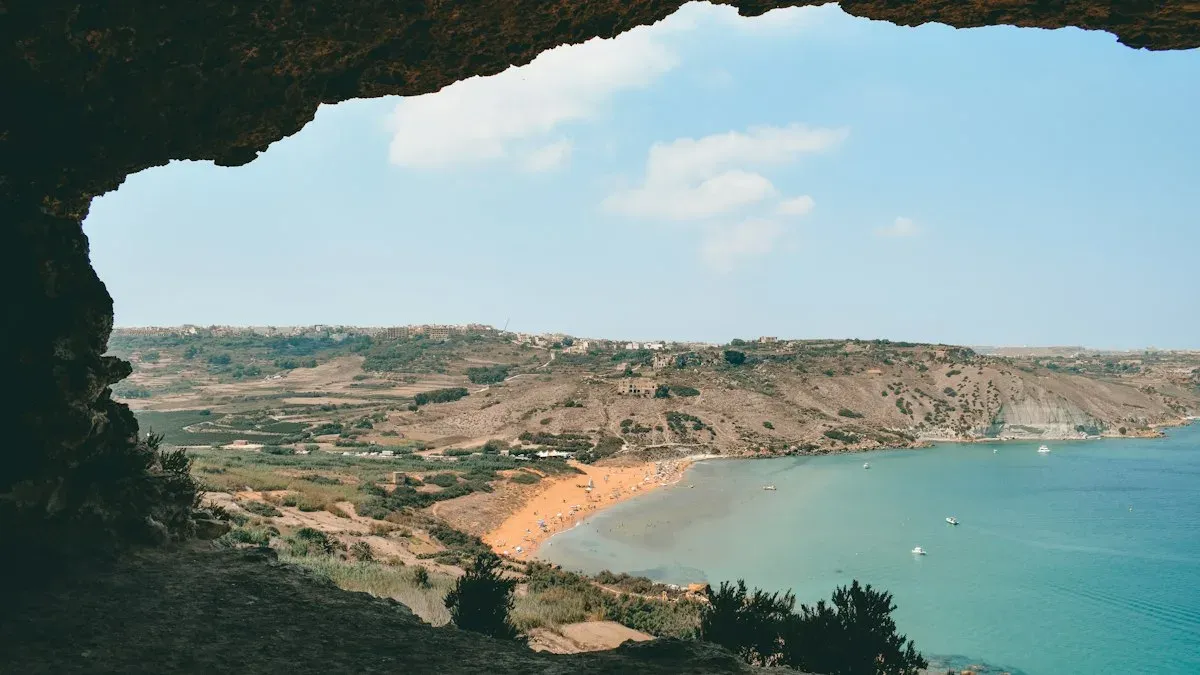
TL;DR: Ramla Bay Gozo is the island’s largest sandy beach, with genuinely red sand caused by iron-rich minerals from surrounding cliffs. It has minimal facilities and no resort infrastructure, making it best suited to those happy with a simple beach day.
Ramla Bay in Gozo is one of the few beaches in the Mediterranean where the sand is genuinely, unmistakably red. Not terracotta, not orange at a stretch. Red. It stops most people in their tracks the first time they see it.
What Makes Ramla Bay Gozo So Different
The colour comes from iron-rich minerals in the sandstone cliffs that surround the bay. Over centuries, erosion has carried that material down onto the beach, producing a shoreline that looks unlike almost anything else in the region. The sand itself is coarser than the powdery white variety you find further east in the Mediterranean, which means it holds heat differently and compacts underfoot in a way that feels almost solid.
Ramla is Gozo’s largest sandy beach, which says something given that Gozo is a small island where rocky coves outnumber sandy stretches by a wide margin. The bay sits on the island’s north coast, sheltered by low hills and flanked by reeds and low scrub vegetation. It is not a purpose-built resort beach. There are a handful of seasonal kiosks, but no hotel perched on the sand and no boardwalk lined with sunbed operators.
That relative simplicity is either a selling point or a mild inconvenience, depending entirely on what you want from a beach day. I will say plainly that I think it is a selling point, though I recognise that travelling with children who need constant access to a toilet and a cold drink complicates the equation.
The Red Sand Beach Gozo Visitors Keep Returning To
What tends to surprise people at a red sand beach in Gozo is that the water is not the secondary attraction. The bay is reasonably well-protected from strong currents in calm conditions, and the sea colour shifts through every shade of blue as you move from the shallows to deeper water. The contrast between the dark red sand and that particular turquoise is striking in a way that photographs cannot fully capture, because the eye adjusts to it in real time as you walk towards the water.
The beach shelves gradually, which makes it manageable for children and confident beginner swimmers. In rougher weather, particularly in autumn and winter, the bay can see strong wave action coming in from the north, and it is worth checking conditions before you commit to a swim. The Maltese met office publishes marine forecasts that are reasonably reliable for Gozo.
Snorkelling directly off the main beach is limited because the sandy seabed offers little in the way of marine life. Head to either side of the bay, towards the rocky outcrops at the edges, and the picture changes considerably. Posidonia seagrass beds, small fish and the occasional octopus make the effort worthwhile.
Getting There and What to Bring: Your Ramla Bay Guide
Ramla Bay is not the easiest beach to reach from most of Gozo’s main towns, which is part of the reason it has retained its character. From Victoria, the island’s capital, you are looking at roughly fifteen minutes by car. Parking is available at the top of the road that descends to the beach, and it fills quickly in July and August. Arriving before ten in the morning or after four in the afternoon sidesteps most of the congestion.
The public bus service does reach Ramla, though the timetable is less frequent than the routes serving Marsalforn or the ferry terminal at Mġarr. If you are relying on public transport, it is sensible to check the Malta Public Transport schedule in advance rather than assuming buses will be regular throughout the day.
In terms of what to bring, the beach has seasonal kiosks selling drinks and basic snacks, but they are not guaranteed to be open outside the core summer months. Bringing your own water, sunscreen and food is the reliable approach. Shade is limited on the beach itself; the dunes at the back of the beach offer some, and there are trees slightly inland, but the bay faces north and gets full sun for most of the day in summer.
History Beneath the Sand
Behind the beach, partly obscured by the reed beds and low vegetation, there is a small cave associated with the myth of Calypso. In Homer’s Odyssey, Calypso detains Odysseus on an island for seven years. Gozo has long claimed to be that island, and the cave above Ramla Bay is the traditional candidate for Calypso’s home. The association is speculative and contested, but the cave itself is real and accessible, and the view down over the bay from that position is worth the short walk regardless of how you feel about Bronze Age mythology.
There are also Roman remains in the area around Ramla. Archaeological work has identified traces of a Roman villa near the beach, which fits with the broader pattern of Roman settlement across Malta and Gozo. Very little of this is visible to a casual visitor today, but it adds something to the sense of the place, the knowledge that people have been drawn to this particular bay for a very long time and for reasons beyond the colour of the sand.
When to Visit
The bay is at its most crowded in July and August, when Maltese families join the international visitors. This is not a problem if you are there early or late in the day, but midday in high summer can feel cramped in a way that is at odds with the beach’s natural character. May, June, September and October offer a better balance: the sea is warm enough for comfortable swimming, and the beach is noticeably quieter.
Winter visits are worthwhile for a completely different reason. The beach is empty, the colour of the sand is more saturated in the lower light, and the walk along the shoreline has a quality that is hard to describe without sounding melodramatic. The water is cold by Mediterranean standards, around fifteen degrees Celsius in January, so swimming is for the determined. But simply being there is not nothing.
Frequently Asked Questions
Is Ramla Bay suitable for families with young children?
Yes, in calm conditions. The beach shelves gradually and the water is relatively calm in summer. The main practical issue is limited facilities outside peak season. Bringing your own supplies is the sensible approach for a family visit.
Can you swim at Ramla Bay year-round?
Technically yes, but practically the answer depends on your cold tolerance and the sea conditions. Summer and early autumn are the most comfortable. Winter water temperatures drop to around fifteen degrees, and wave action from the north can make swimming inadvisable on rougher days.
Is the red sand actually red or is that an exaggeration?
It is genuinely red. Not a pale terracotta or a warm beige. The iron content in the local sandstone gives the beach its distinct colour, and it is one of the few beaches of this type in the entire Mediterranean. The colour is more saturated when the sand is wet.
Are there restaurants or cafes at Ramla Bay?
Seasonal kiosks operate during summer, selling drinks, ice cream and basic food. There are no permanent restaurants on the beach itself. The nearest proper dining options are in Nadur, the closest village, a few minutes by car from the bay.
How far is Ramla Bay from the Gozo ferry terminal?
Mġarr ferry terminal is on the south-eastern tip of Gozo, roughly twenty to twenty-five minutes from Ramla by car. The road takes you through Victoria and then north towards the bay. It is a straightforward drive with clear signage.
The Bottom Line
- Ramla Bay is Gozo’s largest sandy beach and one of the few genuinely red sand beaches in the Mediterranean.
- The colour comes from iron-rich sandstone eroding from the surrounding cliffs over a very long period.
- The beach is best visited in May, June, September or October for a balance of warm water and manageable crowds.
- Facilities are limited outside high season, so bring your own water and food.
- Snorkelling is better at the rocky edges of the bay than in the central sandy area.
- The Calypso Cave above the beach offers a good view and a thread of mythology worth following, even if you take the historical claim lightly.